Payment continuity for research peptide brands · early access
When your acquirer asks, have the answer.
Answer for any order ever shipped: which lot was recorded, and what the customer was shown and accepted. It names the orders where something is missing. Send a document, not an email.
The dashboard
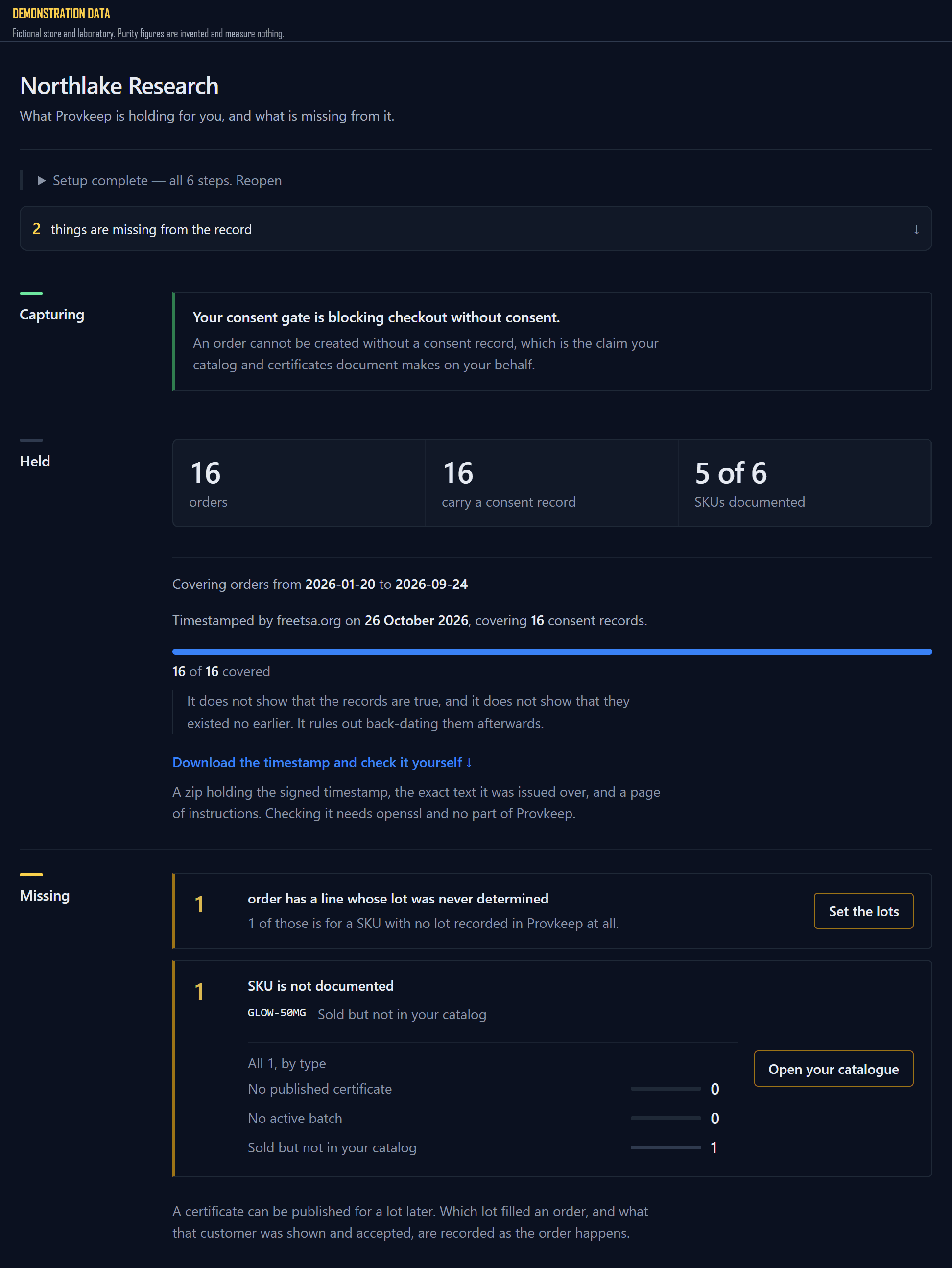
One screen for the whole store: what it is capturing as the orders arrive, what it already holds, and the orders where something is missing.
Each count names the thing behind it — the SKU that is not documented, the order whose lot was never determined — rather than averaging them into a score.
The workflow
Where it fits in what you already do.
The record is written once, as the orders happen. Each of these four moments reads from it.
When you apply or reapply
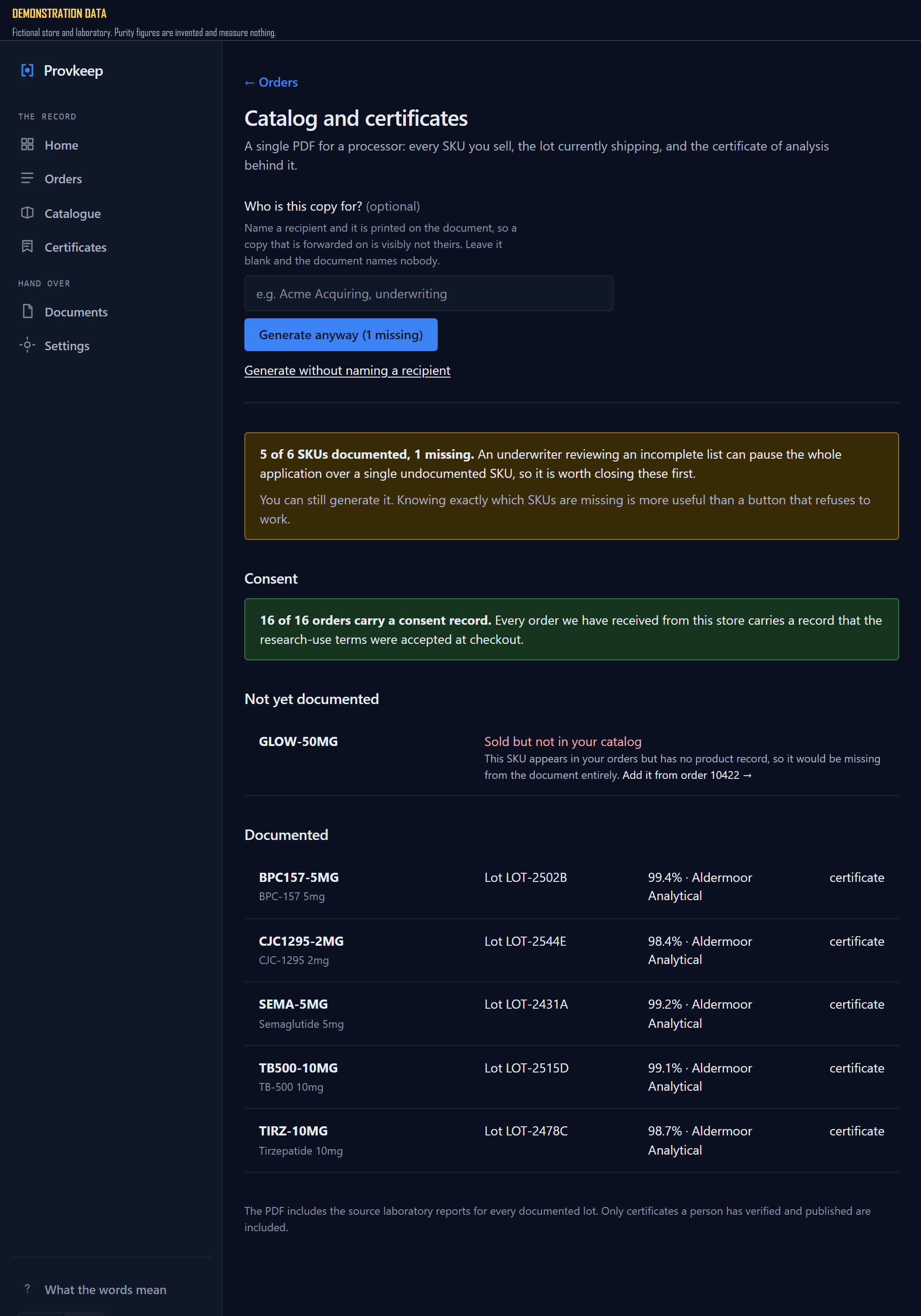
One document for the catalog and its certificates.
Every SKU, the lot shipping now, and the laboratory result published for that lot. It counts what you can document and names what you cannot, before anything is sent.
As the orders arrive
The record is written by the checkout that placed the order.
What the customer was shown and accepted, and which lot filled the order. Held per order, so it is there before anyone asks.
No order placed through this store's checkout is created without a consent record.
Orders created by other routes do not pass through the checkout: an order keyed in by staff, a subscription renewal, a payment link, an order paid with Apple Pay, Google Pay or another express checkout, an upsell that creates a second order after the first, or an order created through the store's API or command line.
The claim holds for a store whose checkout form renders the gate's field. A theme or page builder that replaces the classic checkout template can omit it, and this store is told when that happens rather than the orders being recorded as though the customer declined. On a Blocks checkout WooCommerce renders the field itself, so a theme cannot omit it.
When they ask about specific orders
One document for the orders on their list.
For each order: what the customer was shown and accepted, the minimum age the checkout displayed, the lot that filled it, and the store’s own despatch record where it reported one.
The list is theirs, not a sample you chose. Every identifier they send comes back exactly once — including any you have no order for — so the count you return matches the count they asked about, and the document says on its cover that it describes those orders and nothing else.
Where the store reported despatching an order, the tracking reference and despatch date are held with it — the store's own record of sending a parcel, not a confirmation from the carrier that it arrived. Customer addresses are fingerprinted inside the store before they reach Provkeep, so evidence of delivery for a non-receipt dispute comes from the store's carrier account rather than from here.
When an order is disputed
The response for one order, built from what was already recorded.
The lot recorded for each line and how it was determined, the laboratory result published for that lot, and the consent record from the checkout session that placed the order.
A line it could not account for is declared in the document’s own first section, rather than left for a reviewer to find.
And anyone holding it can check the date
An outside authority timestamped the records.
An outside timestamp authority signed this store's record fingerprint, so the records held at that point existed by that date.
It does not show that the records are true, and it does not show that they existed no earlier. It rules out back-dating them afterwards.
The problem
Of the four facts an underwriter asks about one sale, two are held by nothing.
A question about one sale has four parts: the order, the certificate for the lot, which lot filled that order, and what the customer was shown and accepted. The order is held by the store software, and the certificate exists as a file. The store has no field for a lot, and the terms checkbox writes nothing.
The window closes on the day it ships
The lot that filled an order is knowable on the day it ships and not afterwards. So what accumulates is unrecorded links rather than a pile of work, and answering later means asking someone to remember. No software can go back and supply a lot number for an order that shipped last spring — ours included.
What answers it
The answer is a document you already have.
A record built while the orders happen, so the thing a processor asks for exists before they ask.
A dispute is the occasional case rather than the constant one. When a customer says they never made the purchase, the packet lines that order up against their own earlier orders from you that carry no dispute recorded by this store — same address, same device, same account — and says which reading of the card network's criteria it meets. Whether it qualifies is the issuer's call, not ours.
One thing it does not answer: “I never received it.” Showing delivery means producing the customer’s full address. Your customers’ addresses are fingerprinted inside your own store before anything reaches us, so a break-in here could never become a list of people who bought research peptides. We cannot hold what we would need. That evidence comes from your carrier account, not from us, and no document of ours will imply otherwise.