What your store enforces
Two certificates for one lot, and they do not agree
A supplier sends a retest. A colleague uploads the file that arrived last week. Either way you now hold two laboratory reports for the same lot number, and the one already on your public page says something different.
This is quiet and it is expensive. Nothing on a certificate page looks wrong. The lot is published, the number reads well, a customer can open the report. The problem only exists in the gap between two documents, and the gap is invisible unless somebody happens to compare them line by line.
It matters because the certificate page is the one you are asking customers to trust. A purity figure you have since had reason to doubt is a published claim under your own name. If it later turns out the lot was retested and you kept showing the old result, no amount of documentation elsewhere repairs that.
The comparison happens at the moment of publishing
Publishing a certificate is one human decision, one lot at a time. There is no bulk approve and no automatic publication at any confidence, because the value of a verification is that a person looked at this document.
That decision point is also the only moment when the comparison is useful. So when the lot you are about to publish already has a published certificate in your store, the two are compared field by field and the differences are put in front of you before the publish completes.
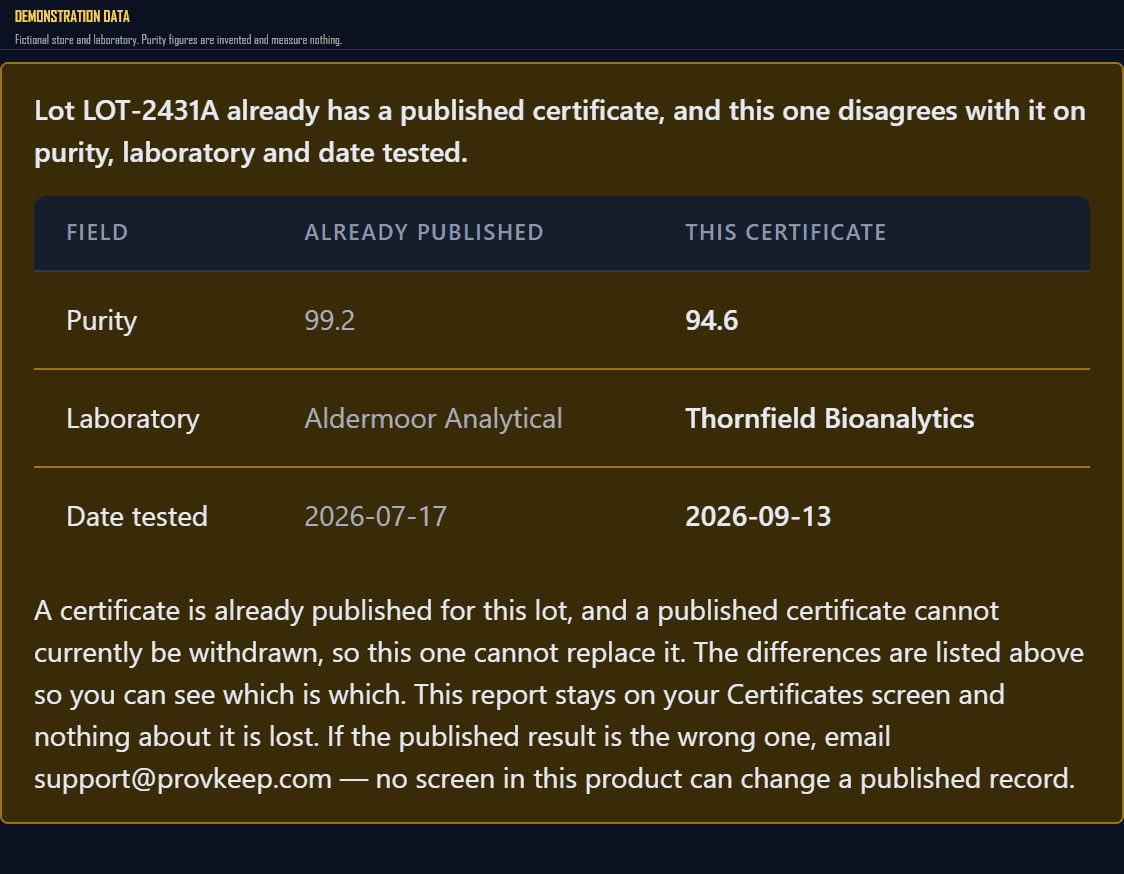
It names the fields that differ rather than raising a general warning. Here the purity has moved by nearly five points, the laboratory is different, and the newer test is two months later. That combination reads as a retest, and the guidance says so while leaving the call to you.
It does not decide anything
The alert does not block the publish, does not pick a winner and does not flag either report as suspect. It cannot: it has no way to know which document is current, and a product that guessed would eventually retire a correct certificate in favour of a stale one.
What it tells you is what the difference is. It does not offer a way to replace the published certificate, because there is not one: a published record cannot be withdrawn or edited by any screen in this product, and your store holds no permission to update or delete one. The new report stays on your Certificates screen, the comparison stays visible, and if the published result is the wrong one that is a conversation with us rather than a button.
What it is comparing
Two documents in your own catalog: the certificate you are publishing now, and the certificate you published earlier for the same lot number. Both columns in that table are your records, for your lot. That is the whole of it.
A published record is never edited, either. Your store holds no permission to update or delete one, so a correction is a new row and the earlier decision stays on the record. That is what makes the comparison above possible at all: the first certificate is still exactly what it was when someone published it.