What your customers see
You paid for the testing. The page should say so.
Sending a vial to a laboratory and waiting three weeks for the result costs real money. It can still buy you a PDF link that looks identical to the one your competitor got free with the lot.
This is the complaint we heard most from operators who take the sourcing seriously. They commission independent analysis on every incoming lot, and they pay for it. The customer has no way to tell them apart from a store that reposted whatever arrived in the box. Both pages say “lab tested”. Both link a PDF. The spend is invisible.
Fixing that is not a matter of adding a badge. Anyone can add a badge. It is a matter of recording who obtained the report, at the moment the report is uploaded, and then printing that fact where a customer reads it.
One question, at the point where you actually know the answer
A certificate enters your store through the upload screen. That is the only moment when the person handling it knows where it came from, so that is where the question is asked. Two answers: you commissioned the test, or it came with the lot.
The field is optional, and the note under it says exactly what leaving it blank does. Not answering is a legitimate choice with no penalty attached, because the alternative would be a product that quietly marks down every merchant who was in a hurry.
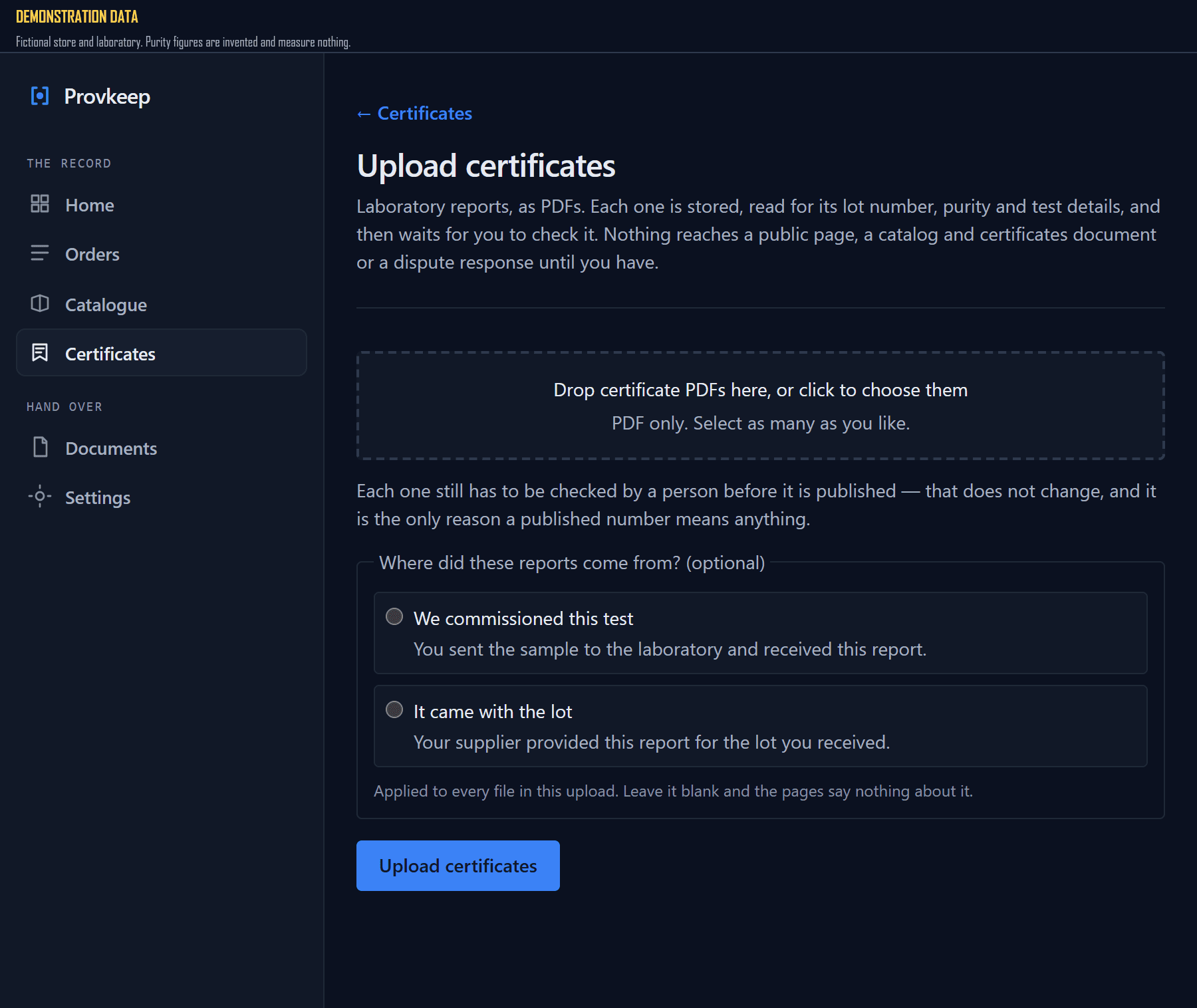
You will notice a third possibility is missing: a report delivered to us by the laboratory directly. It exists in the database and it is deliberately not on this screen. Offering it would mean accepting a claim we have no way to check, since there is no authenticated delivery path from a laboratory into this system yet. When there is one, with a per-merchant intake address and mail authentication actually verified, the option appears. Until then a capability that does not exist is not sold.
What it turns into
A sentence, in your own store’s name, under the values on the public page. It reads as a statement of fact rather than a claim of quality, because that is what it is: this store commissioned this analysis and provided the report. No badge, no tick, no coloured pill next to the laboratory.
That restraint is the reason the sentence is worth anything. A checkmark beside a laboratory name says this laboratory has been checked, and nobody here has checked it. The moment a page starts making that claim, every other careful statement on it becomes suspect too. A reader who has been in this industry for a while knows the difference, and those are the readers worth convincing.
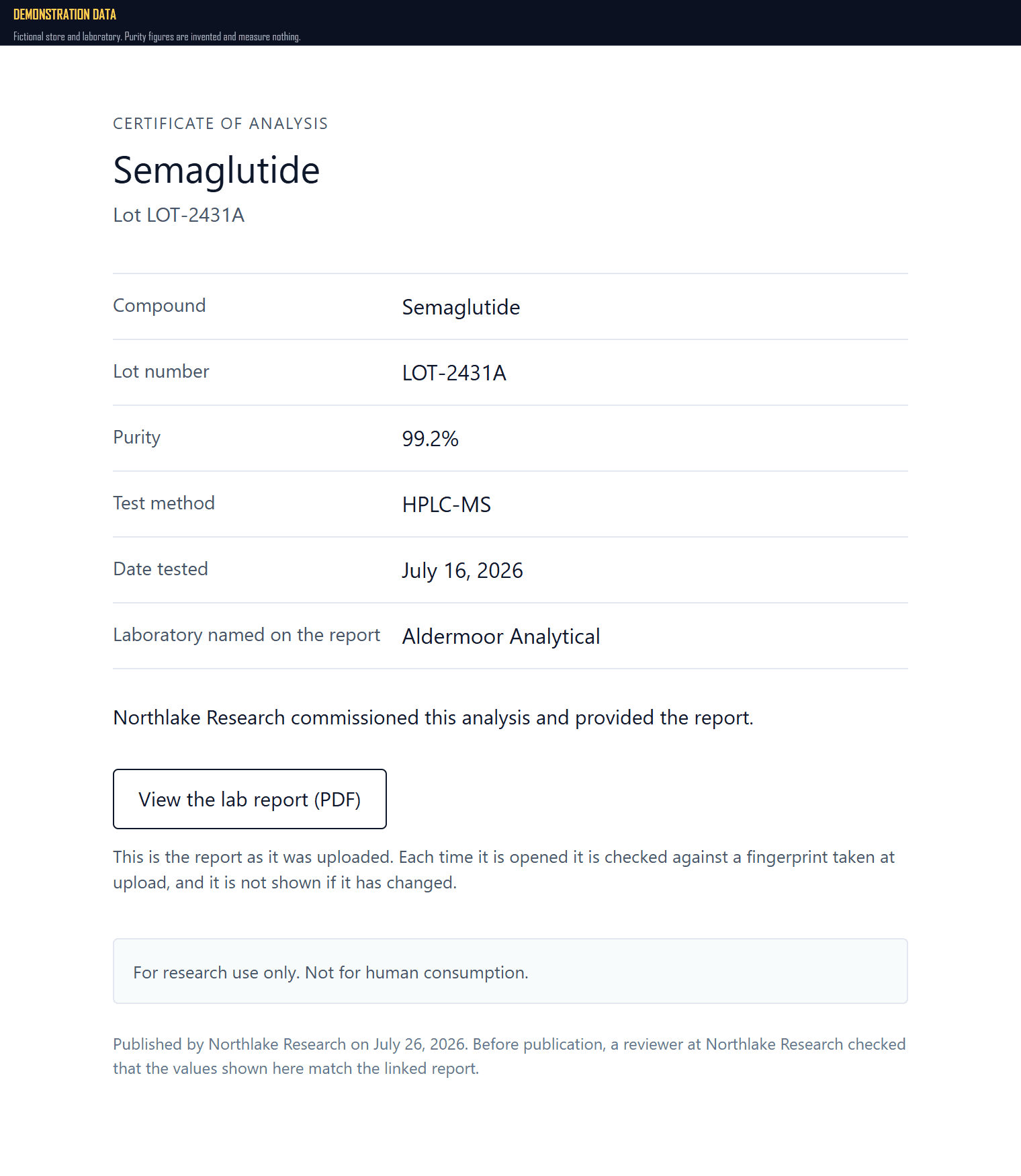
A merchant who resells gets the other sentence, worded so it reads as a normal supply chain rather than a shortfall, because it is one. And the declaration is write-once: your store can record it, and nothing in the product can go back and change it later.