What your customers see
A certificate page per lot, on a URL that does not move
Your customer is looking at a product page and wants to know what is actually in the vial. This is the page you link them to.
A buyer asks the question every research-peptide customer asks, in a support email or in a forum thread: how do I know this is what you say it is? One answer is a PDF attached to a reply. Another is a lab report image uploaded to the product description a year ago that nobody has checked since.
Neither answers the real question, which is not “do you have a certificate” but “does the certificate describe the vial I was sent”. A report attached to a product describes a product. This describes a lot, and the order that shipped from it.
What the page shows, and what it refuses to
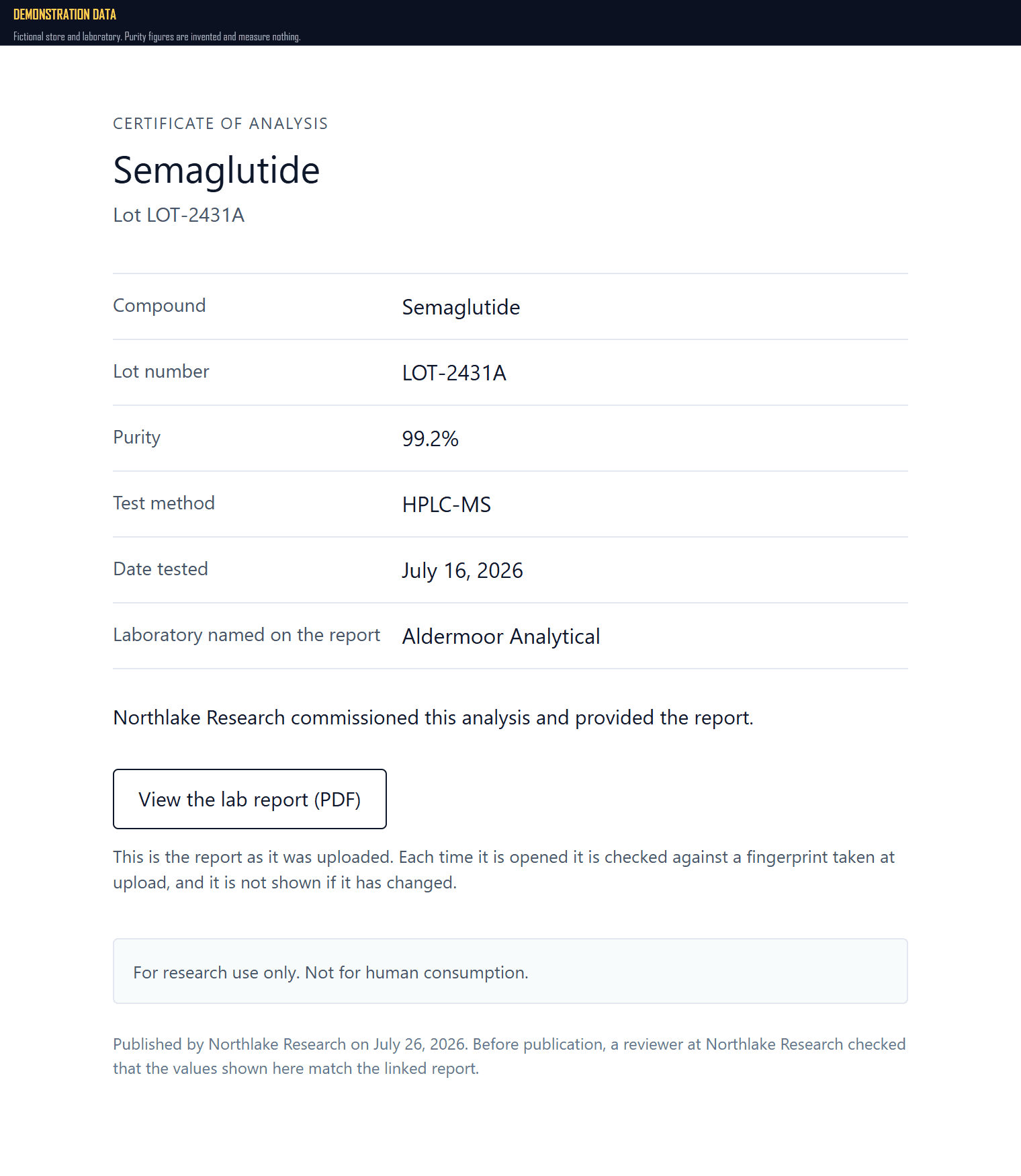
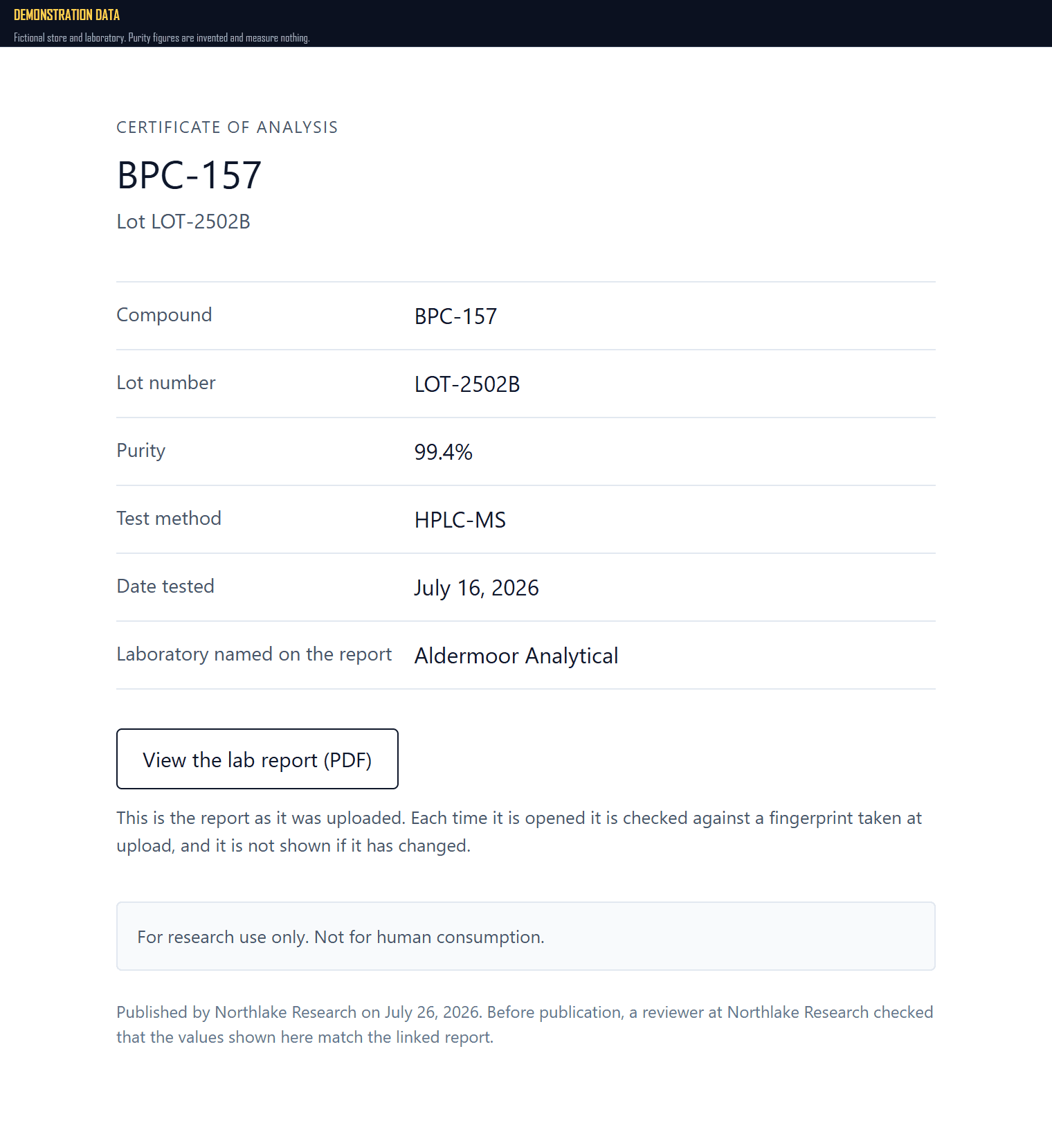
The compound, the lot number, the purity, the method, the date and the laboratory. The source report opens from the page, served through our own server rather than as a storage link. That way, no internal identifier ends up in a URL a customer can read.
What it will not do is tell your customer the result is true. Nobody here re-tested the vial. What a person did was read the report and confirm the values on this page match it, and that is exactly what the footer says: a named reviewer at your store checked that the values shown match the linked report. A page that claimed more would be easy to write and impossible to defend.
Saying where the report came from
Where a store resells rather than commissioning its own testing, the page still has to be right. The certificate came from the supplier with the lot, and there is nothing wrong with that. It is how the supply chain works. But a store that pays for its own third-party testing is doing something materially different, and a page that treats both the same throws that difference away.
So the page states who supplied the report, as a fact. Commissioning your own analysis earns a sentence saying so. Receiving it with the lot earns a sentence saying that instead, worded so it reads as a normal supply chain rather than an accusation.
And a store that has not told us either way gets no sentence at all. That asymmetry is deliberate: declaring earns you something, and not declaring costs you nothing. The alternative — a “not confirmed” label on everyone who has not filled in a field — makes an honest merchant look worse without making a single reader safer.
Why the URL matters as much as the page
The link is per lot and it does not move. You put it on the product page, in the dispatch email, on the vial label if you print one. When the lot changes, the new lot gets its own link, and the old one keeps describing the old lot for as long as you leave it up.
If you need a published link to stop working, revoking it kills that URL permanently rather than repointing it at something else. A customer who bookmarked a certificate and finds it gone learns something true. One who finds it silently showing a different lot’s result learns something false.
The page belongs to your store. You decide which lots get one, when a link goes live, and when it stops working. Nothing else decides what appears there.